
 ,
Sedami Medegan Fagla,
Hyacinthe Finagnon Agnimonhan,
Benedicta Kpadonou-Kpoviessi,
Fernand Gbaguidi,
Salome Kpoviessi
,
Sedami Medegan Fagla,
Hyacinthe Finagnon Agnimonhan,
Benedicta Kpadonou-Kpoviessi,
Fernand Gbaguidi,
Salome Kpoviessi
The integration of medicinal chemistry with modern computational and in silico approaches enables the scientific re-evaluation of traditional knowledge, particularly highlighting the role of organic bioactives products. This study describes the synthesis and pharmacokinetic profiling of a series of organic compounds of pharmaceutical interest that were designed to act as potential bioactive agents. Synthesis strategies were optimized to improve reaction yields. Comprehensive spectroscopic analyses, including nuclear magnetic resonance analysis of protons and carbon-13 (¹H and ¹³C) and mass spectrometry, were employed to verify the molecular structures and evaluate the purity of the synthesized compounds. The synthesized products were then theoretically evaluated for their pharmacokinetics using standard drug-type tests. The results revealed that products were obtained in the best yields (65-82%) using our validated protocols of synthesis and characterized for their structure. For the theoretical study on their pharmaceuticals assessments, most of the compounds exhibited favorable pharmacokinetic profiles (that satisfied the key criteria of Lipinski, and the Connolly parameters (solubility and stability)), as well as demonstrating a good safety profile. This study highlights the importance of combining optimized synthesis methodologies with computational pharmacokinetic screening as an effective method for the initial design and evaluation of new molecules.
| Published in | American Journal of Chemical Engineering (Volume 14, Issue 1) |
| DOI | 10.11648/j.ajche.20261401.11 |
| Page(s) | 1-7 |
| Creative Commons |
This is an Open Access article, distributed under the terms of the Creative Commons Attribution 4.0 International License (http://creativecommons.org/licenses/by/4.0/), which permits unrestricted use, distribution and reproduction in any medium or format, provided the original work is properly cited. |
| Copyright |
Copyright © The Author(s), 2026. Published by Science Publishing Group |
Synthesis, Spectroscopic Characterization, In Silico Pharmacokinetics, Lipinski-compliant Drug-likeness
Compound | Molecular weight (g.mol-1) | LogP | C LogP | Number of H bond donors | Number of H bond acceptors | Number of criteria met |
|---|---|---|---|---|---|---|
Rules | < 500 | < 5 | ≤ 5 | < 10 | at least 3 | |
DPMPT | 331.43 | 5.35 | 4.70 | 2 | 3 | all |
B4CPMPT | 400.32 | 6.46 | 6.24 | 2 | 3 | 3 |
DCPPMPT | 400.32 | 6.46 | 6.12 | 2 | 3 | 3 |
NPPMPT | 376.43 | 4.23 | 4.62 | 2 | 6 | all |
Compound | Connolly Accessible Area (A2) | Connolly Molecular Area (A2) | Connolly Solvent-Excluded Volume (A3) |
|---|---|---|---|
DPMPT | 496.925 | 308.464 | 251.135 |
B4CPMPT | 540.261 | 338.449 | 279.285 |
DCPPMPT | 536.881 | 336.963 | 279.029 |
NPPMPT | 531.091 | 331.516 | 270.678 |
| [1] | Raju, S. K., Settu, A., Thiyagarajan, A., Rama, D., Sekar, P. and Kumar, S. Synthetic approaches of medicinally important Schiff bases: An updated Review. World Journal of Advanced Research and Reviews. 2022, 16(03). 838-852. |
| [2] | Madaboina, S. D. and Kamala, G. R. Structure, Biological Activities and Synthesis of Schiff Bases. Journal of Pharma Insights and Research. 2025, 3(4), 094-101. |
| [3] | Ibrahim, F. M. Polyether Hexadentate Schiff Base Ligand with Trivalent Chromium, Iron, Cobalt Ions. Al-Nahrain Journal of Science. 2017, 20(4), 1-6. |
| [4] | Bassanetti, I., Atzeri, C., Tinonin, D. A. and Marchiò, L. Silver (I) and Thioether-bis (pyrazolyl) methane Ligands: The Correlation between Ligand Functionalization and Coordination Polymer Architecture. Crystal Growth & Design. 2016, 16(6), 3543-3552. |
| [5] | Jaros, S. W., Guedes Da Silva, M. F. C., Florek, M., Smoleński, P., Pombeiro, A. J. L. and Kirillov, A. M. Silver (I) 1, 3, 5-Triaza-7-phosphaadamantane Coordination Polymers Driven by Substituted Glutarate and Malonate Building Blocks: Self-Assembly Synthesis, Structural Features, and Antimicrobial Properties. Inorganic Chemistry. 2016, 55(12), 5886–5894. |
| [6] | Al Zoubi, W., Al-Hamdani, A. A. S., Ahmed, D. S. and Ko Y. G. Synthesis, characterization, and biological activity of Schiff bases metal complexes. Journal of Physical Organic Chemistry. 2018, 31(2), e3752. |
| [7] | Dhokale, N. T., Karale, B. K. and Nagawade, A. V. Synthesis, Characterization and Antibacterial Studies on Mn (II) and Fe (II) Complexes of N, O Donor Salicyloylpyrazoleoxime Schiff Bases. Oriental Journal of Chemistry. 2017, 33(1), 165-172. |
| [8] | Kirca, B. K., Tarı, G. O., Kastas, C. A, Odabasoglu, M. and Buyukgungor, O. Crystal structure, spectral characterization, molecular modeling studies and structural effects of the proton transfer process for (E)-5-methoxy-2-[(3, 4-dimethylphenylimino) methyl] phenol. Macedonian Journal of Chemistry and Chemical Engineering. 2017, 36(2), 265–278. |
| [9] | Sidir, I., Sidir, Y. G., Berber, H. and Demiray, F. Emerging ground and excited state dipole moments and external electric field effect on electronic structure. A solvatochromism and theoretical study on 2-((phenylimino) methyl) phenol derivatives. Journal of Molecular Liquids. 2015, 206, 56–67 |
| [10] | Taresh, B. H. A Review on Schiff Bases Compounds: Synthesis, Application, and a Versatile Pharmacophore: A Review on Schiff Bases Compounds: Synthesis, Application, and a Versatile Pharmacophore. Scientific Journal of Medical Research. 2022, 6(22), 23–26. |
| [11] | Ahmed, A. G., Mohammed, H. A., Mustafea, Z. M. and Fetouh, H. A. Facile and rapid synthesis of a new series of Schiff bases: characterization and evaluation of the physicochemical properties and biological activities. New Journal of Chemistry. 2025, 49, 13357-13368. |
| [12] | Lipinski C. A. Lead- and drug-like compounds: the rule-of-five revolution. Drug discovery today. Technologies. 2004, 1(4), 337–341. |
| [13] | Veg, E., Hashmi, K., Satya, J. S. and Khan, T. Computational Drug-Likeness Studies of Selected Thiosemicarbazones: A Sustainable Approach for Drug Designing. Engineering Proceedings, 2025, 87(1), 35. |
| [14] | Lipinski, C. A., Lombardo, F., Dominy, W. B. and Feeney, J. P. Experimental and computational approaches to estimate solubility and permeability in drug discovery and development settings. Advanced Drug Delivery Reviews. 2001, 46(1-3), 3-26. |
| [15] |
Glinma, B., Medegan, S., Yayi, E., Kpoviessi, D. S. S., Bero, J., Quetin-Leclercq, J., Poupaert, J., Accrombessi, G. and Gbaguidi, F. Benzaldehyde and Derivatives N (4)-Phenyl-3-Thiosemicarbazones: Synthesis, Characterization and Biological Activity. The Pharmaceutical and Chemical Journal. 2020, 7(1), 10-15.
https://tpcj.org/download/vol-7-iss-1-2020/TPCJ2020-07-01-10-15.pdf |
| [16] | Glinma, B., Medegan, S., Yayi, E., Agnimonhan, H. F., Kpoviessi, D. S. S., Quetin-leclercq, J., et al. Lipophilic and structure activity relationships study of thiosemicarbazones and derivatives. International Journal of Advanced Research. 2019, 7(11), 29-40. |
| [17] | Agnimonhan, F. H., Tokoudagba, K. J.-M. D., Glinma, B., Medegan, S., Kassehin, U., Poupaert, H. J. and Gbaguidi, A. F. Study of some carbazones and hydrazones: synthesis, characterization and pharmaceutical properties. Journal of Chemical, Biological and Physical Sciences. 2023, 14(1), 001-010. |
| [18] | Glinma, B., Kpadonou, B., Agnimonhan, H., Medegan, S., Kpoviessi, S., Kapanda, C., Gbaguidi, F. Study of some fluoren-9-one thiosemi-carbazones: Synthesis, catalytic effects and spectral characterization. Universal Journal of Pharmaceutical Research. 2024, 9(5), 30-34. |
| [19] | Glinma, B., Agnimonhan, H., Medegan, S., Ahoussi, A. L., Kpoviessi, S., Poupaert, J., Quetin-Leclercq, J. and Gbaguidi, F. Synthesis, structural study (geometric isomers) and Antiparasitic activity of thiosemicarbazones. World Journal of Pharmaceutical Research. 2021, 10(3), 2040-2053. |
| [20] | Pinto, P., Machado, C. M., Moreira, J.;, Almeida, J. D. P., Silva, P. M. A., Henriques, A. C., Soares, J. X., Salvador, J. A. R., Afonso, C., Pinto, M. et al. Chalcone derivatives targeting mitosis: Synthesis, evaluation of antitumor activity and lipophilicity. European Journal of Medicinal Chemistry. 2019184, 111752. |
| [21] | Soares, J. X., Santos, A., Fernandes, C. and Pinto, M. M. M. Liquid Chromatography on the Different Methods for the Determination of Lipophilicity: An Essential Analytical Tool in Medicinal Chemistry. Chemosensors. 2022, 10(8), 340. |
| [22] | Ulrich, N., Goss, K. U. and Ebert, A. Exploring the octanol–water partition coefficient dataset using deep learning techniques and data augmentation. Communications Chemistry. 2021, 4, 90. |
| [23] | Daina, A., Michielin, O. and Zoete, V. SwissADME: a free web tool to evaluate pharmacokinetics, drug-likeness and medicinal chemistry friendliness of small molecules. Scientific Reports. 2017, 7, 42717. |
| [24] | Hann, M. M. and Keseru, G. M. Finding the sweet spot: The role of nature and nurture in medicinal chemistry. Nature Reviews Drug Discovery. 2012, 11, 355–365. |
| [25] | Rutkowska, E., Pajak, K. and Jozwiak, K. Lipophilicity-methods of determination and its role in medicinal chemistry. Acta poloniae pharmaceutica. 2013, 70(1), 3–18. |
| [26] | Gramatica, P. Principles of QSAR modeling: Comments and suggestions from personal experience. International Journal of Quantitative Structure-Property Relationships. 2020, 5(3), 61-97. |
| [27] | Yabalak, E., Akay, S., Kayan, B., Gizir, A. M. and Yang, Y. Solubility and decomposition of organic compounds in subcritical water,” Molecules. 2023, 28(3), 1000. |
| [28] | Yabalak, E., Gizir, M. A. Subcritical and supercritical fluid extraction of heavy metals from sand and sewage sludge. Journal of the Serbian Chemical Society. 2013, 78(7), 1013-1022. |
| [29] | Glassman, P. M. and Muzykantov, V. R. Pharmacokinetic and Pharmacodynamic Properties of Drug Delivery Systems. Journal of pharmacology and experimental therapeutics. 2019, 370(3), 570-580. |
| [30] | The International Transporter Consortium, “Membrane transporters in drug development. Nature reviews Drug discovery. 2010, 9(3), 215–236. |
| [31] | Poulin, P. and Theil F. P. Prediction of pharmacokinetics prior to in vivo studies. 1. Mechanism-based prediction of volume of distribution. Journal of pharmaceutical sciences. 2002, 91(1), 129–156. |
| [32] | Poulin, P. and Theil, F. P. Prediction of pharmacokinetics prior to in vivo studies. II. Generic physiologically based pharmacokinetic models of drug disposition. Journal of pharmaceutical sciences. 2002b, 9(5), 1358–1370. |
APA Style
Glinma, B., Fagla, S. M., Agnimonhan, H. F., Kpadonou-Kpoviessi, B., Yayi, E., et al. (2026). Synthesis and Pharmacokinetic Evaluation of Novel Bioactive Organic Compounds. American Journal of Chemical Engineering, 14(1), 1-7. https://doi.org/10.11648/j.ajche.20261401.11
ACS Style
Glinma, B.; Fagla, S. M.; Agnimonhan, H. F.; Kpadonou-Kpoviessi, B.; Yayi, E., et al. Synthesis and Pharmacokinetic Evaluation of Novel Bioactive Organic Compounds. Am. J. Chem. Eng. 2026, 14(1), 1-7. doi: 10.11648/j.ajche.20261401.11
AMA Style
Glinma B, Fagla SM, Agnimonhan HF, Kpadonou-Kpoviessi B, Yayi E, et al. Synthesis and Pharmacokinetic Evaluation of Novel Bioactive Organic Compounds. Am J Chem Eng. 2026;14(1):1-7. doi: 10.11648/j.ajche.20261401.11
@article{10.11648/j.ajche.20261401.11,
  author = {Bienvenu Glinma and Sedami Medegan Fagla and Hyacinthe Finagnon Agnimonhan and Benedicta Kpadonou-Kpoviessi and Eleonore Yayi and Joachim Gbenou and Jacques Poupaert and Fernand Gbaguidi and Salome Kpoviessi},
  title = {Synthesis and Pharmacokinetic Evaluation of Novel Bioactive Organic Compounds},
  journal = {American Journal of Chemical Engineering},
  volume = {14},
  number = {1},
  pages = {1-7},
  doi = {10.11648/j.ajche.20261401.11},
  url = {https://doi.org/10.11648/j.ajche.20261401.11},
  eprint = {https://article.sciencepublishinggroup.com/pdf/10.11648.j.ajche.20261401.11},
  abstract = {The integration of medicinal chemistry with modern computational and in silico approaches enables the scientific re-evaluation of traditional knowledge, particularly highlighting the role of organic bioactives products. This study describes the synthesis and pharmacokinetic profiling of a series of organic compounds of pharmaceutical interest that were designed to act as potential bioactive agents. Synthesis strategies were optimized to improve reaction yields. Comprehensive spectroscopic analyses, including nuclear magnetic resonance analysis of protons and carbon-13 (¹H and ¹³C) and mass spectrometry, were employed to verify the molecular structures and evaluate the purity of the synthesized compounds. The synthesized products were then theoretically evaluated for their pharmacokinetics using standard drug-type tests. The results revealed that products were obtained in the best yields (65-82%) using our validated protocols of synthesis and characterized for their structure. For the theoretical study on their pharmaceuticals assessments, most of the compounds exhibited favorable pharmacokinetic profiles (that satisfied the key criteria of Lipinski, and the Connolly parameters (solubility and stability)), as well as demonstrating a good safety profile. This study highlights the importance of combining optimized synthesis methodologies with computational pharmacokinetic screening as an effective method for the initial design and evaluation of new molecules.},
 year = {2026}
}
TY  - JOUR
T1  - Synthesis and Pharmacokinetic Evaluation of Novel Bioactive Organic Compounds
AU  - Bienvenu Glinma
AU  - Sedami Medegan Fagla
AU  - Hyacinthe Finagnon Agnimonhan
AU  - Benedicta Kpadonou-Kpoviessi
AU  - Eleonore Yayi
AU  - Joachim Gbenou
AU  - Jacques Poupaert
AU  - Fernand Gbaguidi
AU  - Salome Kpoviessi
Y1  - 2026/01/26
PY  - 2026
N1  - https://doi.org/10.11648/j.ajche.20261401.11
DO  - 10.11648/j.ajche.20261401.11
T2  - American Journal of Chemical Engineering
JF  - American Journal of Chemical Engineering
JO  - American Journal of Chemical Engineering
SP  - 1
EP  - 7
PB  - Science Publishing Group
SN  - 2330-8613
UR  - https://doi.org/10.11648/j.ajche.20261401.11
AB  - The integration of medicinal chemistry with modern computational and in silico approaches enables the scientific re-evaluation of traditional knowledge, particularly highlighting the role of organic bioactives products. This study describes the synthesis and pharmacokinetic profiling of a series of organic compounds of pharmaceutical interest that were designed to act as potential bioactive agents. Synthesis strategies were optimized to improve reaction yields. Comprehensive spectroscopic analyses, including nuclear magnetic resonance analysis of protons and carbon-13 (¹H and ¹³C) and mass spectrometry, were employed to verify the molecular structures and evaluate the purity of the synthesized compounds. The synthesized products were then theoretically evaluated for their pharmacokinetics using standard drug-type tests. The results revealed that products were obtained in the best yields (65-82%) using our validated protocols of synthesis and characterized for their structure. For the theoretical study on their pharmaceuticals assessments, most of the compounds exhibited favorable pharmacokinetic profiles (that satisfied the key criteria of Lipinski, and the Connolly parameters (solubility and stability)), as well as demonstrating a good safety profile. This study highlights the importance of combining optimized synthesis methodologies with computational pharmacokinetic screening as an effective method for the initial design and evaluation of new molecules.
VL  - 14
IS  - 1
ER  -
Chemistry Department, University of Abomey-Calavi (LaCOSNA/FAST/UAC), Abomey-Calavi, Benin;Chemistry Department, University of Abomey-Calavi (MOCL/FSS/UAC), Cotonou, Benin;School of Pharmacy, Catholic University of Leuven (LDRI/UCL), Brussels, Belgium
Chemistry Department, University of Abomey-Calavi (MOCL/FSS/UAC), Cotonou, Benin
Chemistry Department, University of Abomey-Calavi (LaCOSNA/FAST/UAC), Abomey-Calavi, Benin
Chemistry Department, University of Abomey-Calavi (LaCOSNA/FAST/UAC), Abomey-Calavi, Benin
Chemistry Department, University of Abomey-Calavi (MOCL/FSS/UAC), Cotonou, Benin
Chemistry Department, University of Abomey-Calavi (LaCOSNA/FAST/UAC), Abomey-Calavi, Benin
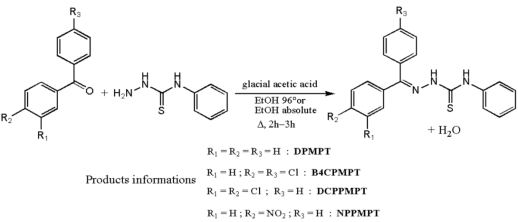
Figure 1. Synthesis route of products.
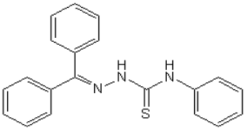
Figure 2. 1-(diphenylmethylene) N-(4)-phenyl-3-thiosemicarbazide (DPMPT).
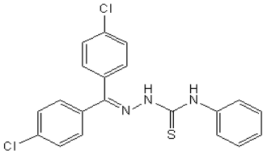
Figure 3. 1-[bis(4-chlorophenyl)methylene] N-(4)-phenyl-3-thiosemicarbazide (B4CPMPT).
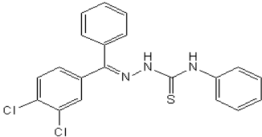
Figure 4. 1-[(3,4-dichlorophenyl)(phenyl)methylene] N-(4)-phenyl-3-thiosemicarbazide (DCPPMPT).
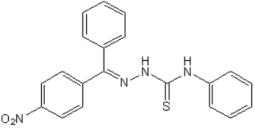
Figure 5. 1-[(4-nitrophenyl)(phenyl)methylene] N-(4)-phenyl-3-thiosemicarbazide (NPPMPT).

Information


 Share This Article
 Twitter
 Linked In
 Facebook
 Copy
Copy Download